



June 2026
What Good Education Workflows Look Like in the Age of AI.
AI is changing how education teams create content, but speed alone does not solve workflow fragmentation. This blog explores what connected education workflows actually look like in the age of AI — and why clarity, visibility, and coordination are becoming the real productivity advantage.
The first blog in this series made one argument: AI is a tool, not an authority.
The second made another: once AI enters the workflow, coordination becomes the real challenge.
Which leaves the obvious question.
If fragmented workflows are the problem, what does a connected one actually look like? Not in theory. Not in a diagram. But in the real, day-to-day work of an education team.
That is what this piece is about.
Most teams already have enough tools
If you look at a typical education or curriculum team today, the setup usually looks complete on paper.
Something for writing. Something for communication. Something for approvals. Something for tracking. Something for content generation. Something for delivery.
Everything exists. Nothing is obviously missing.
And yet the work still feels fragmented.
Because the problem was never the tools. It is how, or whether, they connect. Each tool handles one part of the workflow, but no single system shows how work actually moves from start to finish. The full picture is invisible, spread across platforms that were never designed to talk to each other.
The real problem is not creation. It is flow.
Most education workflows today are built around tasks, not systems.
Something gets written in one place. Reviewed in another. Approved somewhere else. Published somewhere else entirely. Every handoff between those stages creates friction, and friction compounds quietly over time.
It shows up as version confusion, three people working from different drafts of the same document. Lost feedback, a comment buried in an email chain that nobody goes back to find. Duplicated work, two team members revising the same section without knowing it. Unclear ownership, a piece of content that exists but has no clear next step.
The work is happening. But it is not flowing.
What connected workflows actually feel like
When workflows are genuinely connected, the change is not dramatic at first. It is subtle.
People stop asking where things are. They stop chasing the latest version. They stop spending the first ten minutes of every task rebuilding context about where something left off.
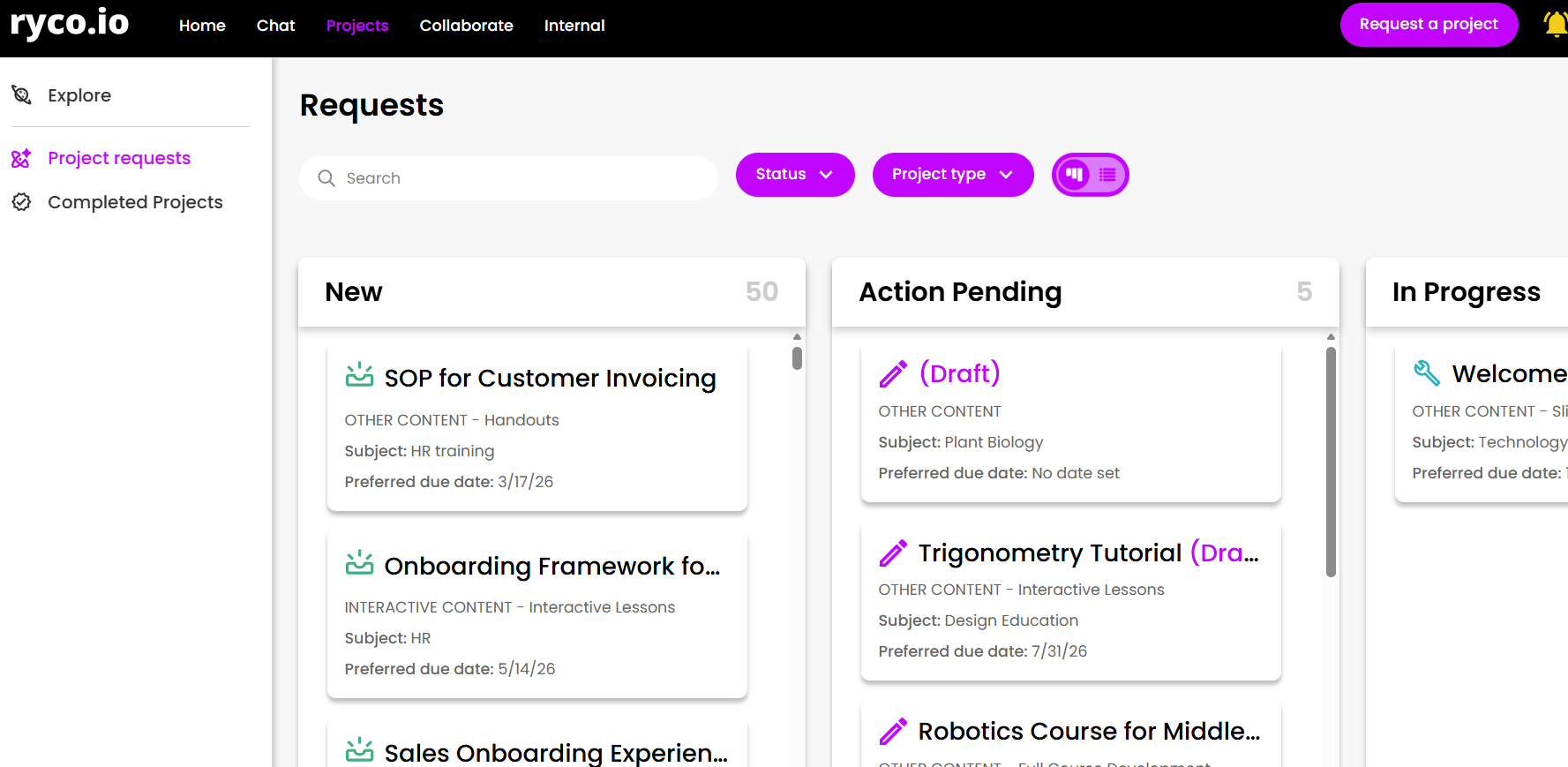
In a connected system, projects live in one place. Feedback is attached directly to the work it references. Version history is always visible without having to ask. Progress is easy to follow for everyone involved. Ownership is clear at every stage.
Work stops feeling like separate pieces moving across disconnected tools. It becomes one continuous flow from first draft to final delivery, without the gaps in between.
Clarity is the real productivity gain
Most conversations about productivity in education focus on speed. More output. Faster turnaround. Shorter timelines.
But for most education teams, speed is not actually the bottleneck.
Clarity is.
When teams are not constantly searching for files, checking which version is current, re-explaining feedback that was already given, or chasing someone for an update, they get something more valuable than speed.
They get mental space back.
Space to think carefully. Space to refine the work. Space to actually focus on teaching and creating instead of on coordinating. That is what most tools do not optimize for. They optimize output. They do not optimize understanding.
Where AI fits and where it does not
AI fits naturally into this picture, but not in the way most teams expect.
AI accelerates parts of the workflow. It helps draft lesson plans, translate materials, structure content, and move through early-stage creation faster than before. That is real and valuable.
But AI does not fix workflow. If the system underneath is fragmented, AI simply produces more output that still needs to be organized, reviewed, approved, and delivered through the same broken process. More content does not solve coordination. It increases the need for it.
The teams that get the most from AI are the ones that already have a clear way of working. AI makes a good workflow faster. It does not make a fragmented one better.
What we have been building at ryco.io
This is the problem that has shaped how we build the ryco.io platform.
Not just how to make content creation faster for education teams, but how to make the entire workflow feel connected once AI becomes part of it.
rybot, our AI assistant inside the platform, helps teams draft lesson plans, translate and adapt materials, structure educational content, and prepare classroom resources. But the part that matters most is not what rybot creates. It is where that work lives after it is created.
Instead of generating content in one tool and then moving it through email, chat, and spreadsheets to get it reviewed and approved, teams can create, revise, collaborate on, and deliver work inside the same connected system. Fewer handoffs. Less context switching. A clearer view of where everything stands.
The goal is not faster output in isolation. There are fewer breaks in the flow from start to finish.
The next generation of education platforms
The next evolution of education tools will not be won by whoever generates content the fastest. That capability is already widely available and improving constantly.
It will be won by whoever reduces fragmentation.
By the platforms that make work visible, where it is, who owns it, and what needs to happen next. By the systems that connect creation, feedback, and delivery into one continuous process instead of a series of handoffs across disconnected tools.
Because once AI becomes a normal part of how education teams work, the challenge is no longer creating enough content. It is keeping everything organized, aligned, and moving forward as that content scales.
What good actually looks like
Good is not complicated, but it is specific.
It is a team that does not spend half its meeting asking where things are. It is feedback that gets seen and acted on instead of being buried. It is a draft that moves cleanly from creation to review to approval without losing track of anything along the way. It is clarity about what is done, what is in progress, and what still needs attention, without anyone having to ask.
That is what a connected workflow delivers. Not just speed. Confidence.
If this is the kind of clarity your team is working toward, we would love to show you how ryco.io approaches it.
AI has already changed how education teams create. The next step is building workflows that are actually designed for how that work moves.
We built ryco.io for exactly that. Come take a look at ryco.io and see what a connected workflow can feel like for your team.