



June 2026
What Happens After AI Enters the Workflow?
AI made content faster. But it also made workflows messier. The real problem in education isn’t creating content anymore—it’s coordinating it.
AI can help education teams create content faster. But faster content has not made coordinating that content any simpler.
That is the tension most teams are quietly navigating right now.
The adoption question is largely settled
For education leaders and curriculum teams, AI is no longer a pilot program or a future consideration. It is already in the room.
Lesson plans get drafted in minutes. Assessments come together faster. Materials get summarized, translated, and restructured. Teams are using AI to move through the early stages of almost every project more quickly than before.
And in many ways, that is genuinely useful.
But speed was never the only problem.
More output does not automatically mean less friction
When content becomes easier to generate, teams naturally produce more of it. More drafts. More variations. More versions of the same idea are being developed in parallel.
Output increases, but the systems around that output often stay the same.
Files end up spread across different tools. Feedback arrives through email, chat, and shared documents — sometimes all three at once. It becomes unclear what is current, what has been approved, and what is still being revised. The content itself moves faster, but the workflow around it starts to feel less controlled.
The real complexity is in what comes after creation
AI is genuinely good at helping teams start. Brainstorming, first drafts, research, repetitive formatting work — these are areas where AI delivers real time savings.
But in education, most of the meaningful work does not happen at the beginning. It happens after.
Reviewing content for accuracy. Gathering feedback from multiple stakeholders. Moving through revision cycles. Coordinating approvals. Managing version histories. Preparing final materials for delivery. These are the stages where projects slow down, especially when teams are working across different tools without a clear shared process.
Curriculum changes frequently. Accuracy matters. Multiple people need to weigh in at different points. Deadlines are structured and real. When the workflow is not clearly organized, faster creation can actually generate more coordination work — not less.
The problem is usually visibility, not effort
In most teams, the issue is not that people are not working hard enough. It is that it is genuinely difficult to see what is happening.
Teams lose time to simple questions: Which version is current? Has this been reviewed? Where did that feedback end up? Is this ready to move forward?
These questions feel small on their own. But they interrupt focus constantly, and over time, that fragmentation adds up to something that slows a team down far more than the actual tasks ever would.
This is what most AI conversations do not address. AI can generate content at speed, but it does not organize how that content moves through a team. It does not track decisions, surface what needs attention, or give everyone a shared view of where things stand.
The next phase is about integration, not just creation
As AI becomes a consistent part of daily work, the conversation naturally shifts.
It is no longer about whether to use AI. Most teams already do. The question now is how AI fits into the broader system of how work actually gets done.
How it connects to review and approval processes. How feedback gets collected and resolved. How work moves from draft to delivery in a way that everyone on the team can follow. How structure stays intact when the pace of content creation increases?
The teams that are most effective right now are not necessarily the ones using the most AI tools. They are the ones with the clearest way of working — where roles are understood, progress is visible, and coordination does not require constant manual effort.
What we are building at ryco.io
This is the problem we think about while building the ryco.io platform.
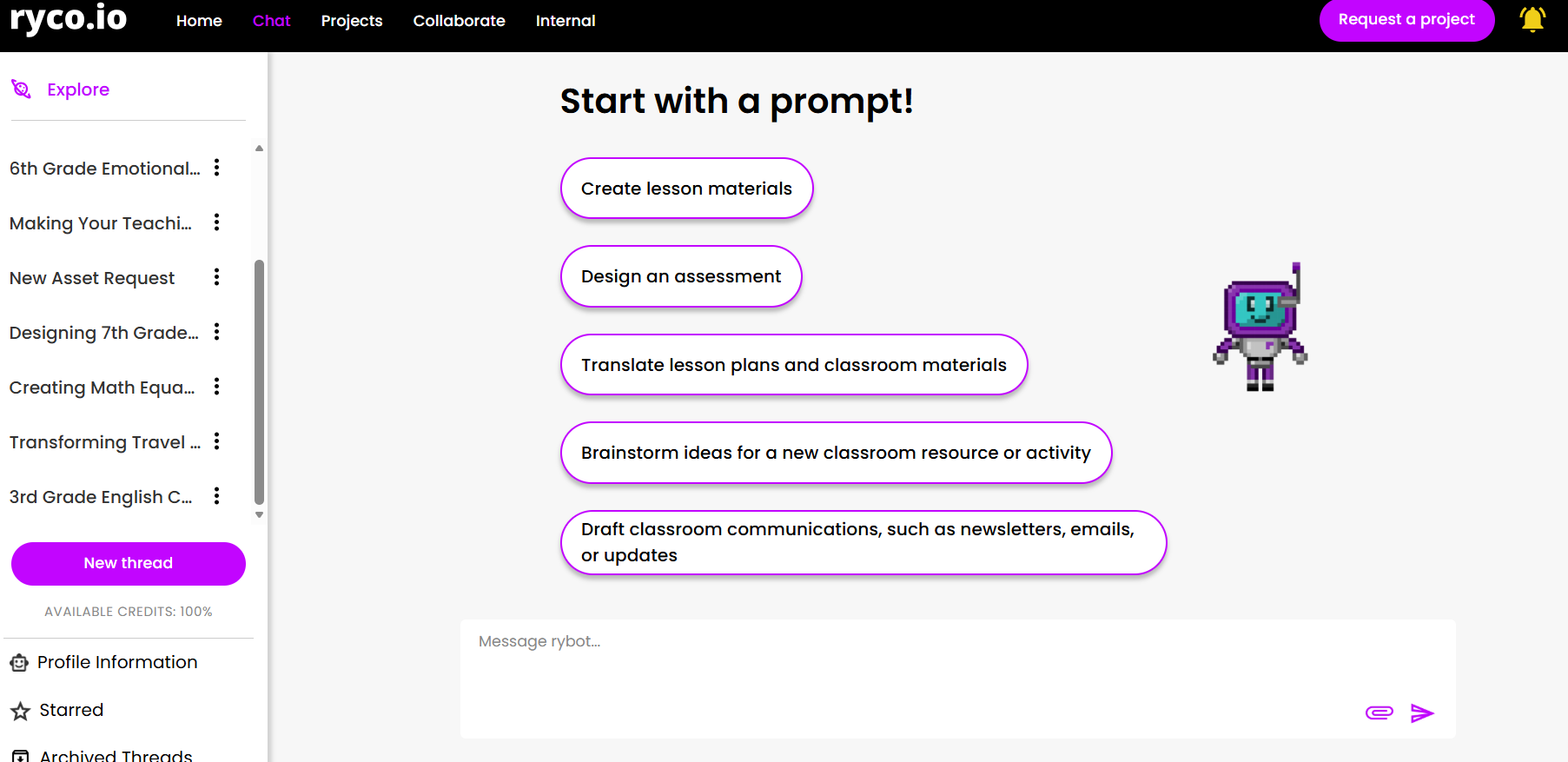
Not just how AI can help education teams create content more efficiently, but how the workflow stays connected once AI becomes part of it. rybot, our AI assistant within the platform, helps teams draft lesson plans, translate and adapt materials, structure educational content, and move through the early stages of curriculum work with less friction.
But the goal behind rybot is not speed alone. It is reducing the fragmentation that tends to build up when fast content creation meets slow coordination.
Instead of moving between disconnected tools and losing track of where things stand, teams can create, review, revise, and manage their work in one connected place. Because once AI becomes part of the workflow, structure matters just as much as speed.
Closing thought
AI is already changing how education teams work. But adding AI to a fragmented workflow does not fix the fragmentation. In many cases, it makes the gaps more visible.
The next step for most teams is not learning how to use more AI tools. It is learning how to design workflows that stay clear and connected as AI becomes part of them.
Because the future of education work will not be measured by how quickly content gets created.
It will be measured by how well teams can actually move that work forward — together, with confidence, and without losing things along the way.
At ryco.io, that is the problem we are working on.